

BP09B – Consumer consumes an application resource from a Provider
To help understand the content of this document, readers should familiarize themselves with the key definitions and actors.
Overview
This business process covers the situation where an Application Consumer has a usage contract for a certain application resource, and seeks to access that application resource from the Application Provider either within the same data space or from a federated data space. The aim of the process is to facilitate secure, transparent, and contractually governed access to an application resource within a data space, ensuring that both Application Providers and Application Consumers have clearly defined rights and obligations. The consumption of an application resource can be done through 4 possible scenarios:
- Scenario 1: Code transfer – The application code is directly transferred from the Application Provider to the Application Consumer, who executes it on their own environment or simply uses it for other purposes (e.g. by integrating it into one of its components);
- Scenario 2: Application bundled with the provisioning of infrastructure - The application is made available to the Application Consumer in a pre-packaged processing bundle that includes application and infrastructure, all pre-configured by the Application Provider. This corresponds to business process 8, where the post configuration of the infrastructure includes the deployment of the application resource;
- Scenario 3: Deployment on infrastructure from an Infrastructure Provider or on local/cloud infrastructure – The Application Consumer deploys the application on an on-premises/cloud infrastructure or on an infrastructure previously acquired from an Infrastructure Provider;
- Scenario 4: Access to Application-as-a-Service – The Application Consumer requests access to a managed service from the Application Provider through the application catalogue.
The bundle scenario (scenario 2) and Application-as-a-Service scenario (scenario 4) make the application available in an environment controlled by the Application Provider, which allows them to control and monitor the usage of the application resource. For scenario 2 and scenario 3, the monitoring functionalities of Simpl-Open can be used. With code transfer (scenario 1) or the deployment of the application on local infrastructure, controlling or monitoring the usage of the application resource is not supported since the application resource is transferred to the Application Consumer. These scenarios are mostly appropriate for open-source applications, where the Application Provider accepts that the Application Consumer will run, modify, and control the application independently.
It includes the following main steps:
- Request application resource: The Application Consumer initiates the process by requesting a specific application resource from the Application Provider. This request is based on the information previously identified by the Application Consumer either in the local application catalogue or through federated cross-data-space catalogue search.
- Provide access to the application resource: The Application Provider provides the Consumer with the credentials and configurations to access and/or deploy the application.
Actors
The following actors are involved:
- Application Provider
- Application Consumer
Assumptions
The following assumptions are made for scenario 3:
- The Application Consumer must have an application deployer component capable of reaching the target execution environment to perform the application deployment instructions, including in federated scenarios where the deployment instructions originate from a federated data space.
Prerequisites
The following prerequisites must be fulfilled for all scenarios:
- Data space is configured: The Governance Authority has configured the catalogue with the corresponding vocabulary and schemas to have the general structure of a resource description, contract clauses, and other foundational components (Business Process 2);
- Application Consumer / Application Provider onboarded: Both the Application Consumer and Application Provider must complete the onboarding process (Business Process 3A) before they can consume or provide any available resources;
- End User authenticated & authorised: The End User is authenticated and has the appropriate role and permissions to perform the steps in the process (Business Process 3B);
- Resource description is present in the data space catalogue: The application resource must be published in the application catalogue including its possible scenarios for application sharing with the Application Consumer (Business Process 5B);
- Resource is selected in the data space catalogue: The application resource can be found by the Application Consumer in the application catalogue (Business Process 6);
- Usage contract established for the application resource. A usage contract for the application resource must be in place to govern the terms of consumption (Business Process 7).
- In the case of application resource consumption from a federated catalogue:
- Federation is configured: Federation relationships between the participating data spaces are established and configured through Tier 2 federation and identity attribute mapping (Business Process 2D).
- Federated catalogue search is configured: Federated cross-data-space catalogue search is configured between directly federated data spaces (Business Process 6 / R25).
- Resource description is present in a federated data space catalogue: The application resource description is published in a federated data space catalogue and is discoverable according to the configured federation relationships and access policies.
- Usage contract is established across federated data spaces: The Application Consumer and Application Provider have established a valid usage contract for the application resource through BP07.
Additionally, following prerequisites must be fulfilled for scenario 2:
- Resource description is present in the data space catalogue: The publication of the application resource includes a reference to the deployment script and post provisioning with the deployment of the application and the infrastructure (Business Process 5B).
Additionally, following prerequisites must be fulfilled for scenario 3:
- Resource description is present in the data space catalogue: The publication of the application resource must include following information (Business Process 5B):
- The requirements for the runtime environment needed to use the application;
- The application deployment instructions.
There are no additional prerequisites for scenario 1 and 4.
Details
The following shows the detailed business process diagram and gives the step descriptions.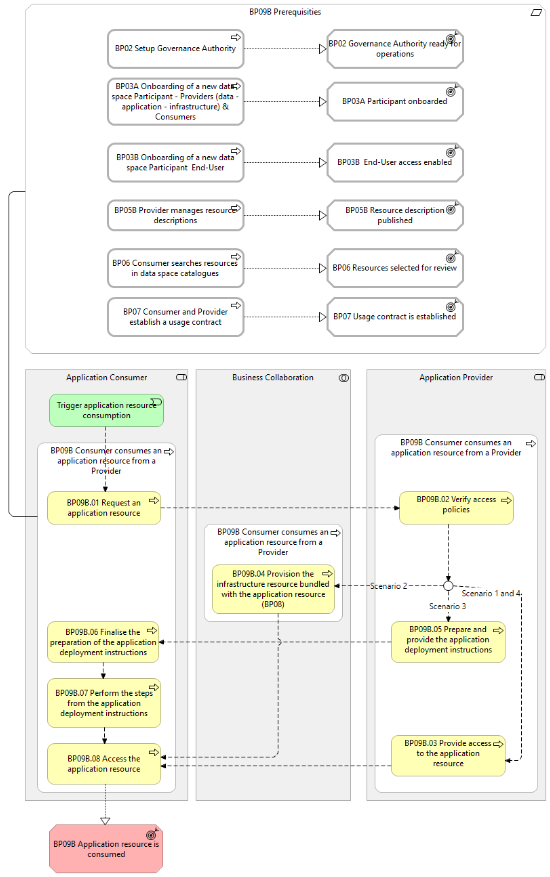
Trigger application resource consumption
The Application Consumer initiates the process to consume an application resource from an Application Provider, either within the same data space or from a federated data space.
BP09B.01 Request an application resource
The Application Consumer selects an application either from the local application catalogue or from a federated data space catalogue. Depending on the scenario for application sharing, following actions are taken by the Application Consumer:
- Scenario 1: Specify the contact information for providing credentials/connection details so that the application code can be accessed by the Application Consumer;
- Scenario 2: Specify the contact information (such as an email address) where notifications related to the provisioning process and the application access information should be delivered;
- Scenario 3: Specify the destination (endpoints and access credentials) so that the application deployment instructions can be made available to the Application Consumer;
- Scenario 4: Specify the contact information for providing credentials/connection details so that the managed service can be accessed by the Application Consumer.
BP09B.02 Verify access policies
The Application Provider verifies whether the Consumer complies with the consumption access policies. The Consumer is notified of non-compliance with access policies.
Scenario 1 & 4: Access to application code or managed service
BP09B.03 Provide access to the application resource
The Application Provider provides access to the application code or managed service by providing the required credentials and connection details to the Application Consumer (e.g., for application code: git access token or similar credentials, for hosted services: service URL, API key, or equivalent information), regardless of whether the Application Consumer belongs to the same data space or to a federated data space.
Scenario 2: Application bundled with the provisioning of infrastructure
BP09B.04 Provision the infrastructure resource bundled with the application resource (BP08)
The Application Provider provisions the infrastructure and then deploys the application on that provisioned infrastructure. The deployment occurs automatically via the infrastructure provisioning mechanism, and the deployment script that is linked to the resource description:
- The Application Provider provisions the infrastructure resource (BP08.03);
- The Application Provider performs the post configuration process, which includes the deployment of the application resource (BP08.04);
- The Application Provider provides access to the infrastructure resource by providing the required credentials and connection details to the Application Consumer (BP08.05).
Scenario 3: Deployment on infrastructure from an Infrastructure Provider or local infrastructure
BP09B.05 Prepare and provide the application deployment instructions
The Application Provider prepares and configures the application deployment instructions by:
- Providing the selected set of application deployment instructions to the Application Consumer.
As a result, the application deployment instructions are made available in a preconfigured way to the Application Consumer. Some of the configured variables are placeholder variables that need to be completed by the Application Consumer (Step BP09B.05). This ensures that they retain full control over sensitive information.
BP09B.06 Finalise the preparation of the application deployment instructions
The Application Consumer finalises the preparation of the application deployment instructions by:
- Setting the placeholder variables that were not provided in step BP09B.04;
- Injecting sensitive credentials (e.g., database passwords, API tokens);
- Customising runtime parameters.
BP09B.07 Perform the steps from the application deployment instructions
The Application Consumer performs the steps from the application deployment instructions so that the application resource can be consumed on their target runtime environment.
BP09B.08 Access the application resource
The Application Consumer consumes the application resource via the channel indicated on the resource description, either within the same data space or across federated data spaces according to the configured federation relationships.
Outcomes
- Application resource is consumed: The Application Consumer accesses and consumes an application resource provided by the Application Provider, either within the same data space or across federated data spaces according to the configured federation relationships, following the policies from the established usage contract.
| Business Process | Status: Proposed |
High Level Requirements
9B.1 - A Consumer requests an application resource
Simpl shall allow a Consumerto request ...9B.2 - A Provider verifies the consumption access policies of an application resource consumption request
Simpl-Open shall support Provider to automatically ...9B.3 - A Provider provides access to the application resource
Simpl-Open shall allow a Provider to provide ...9B.4 - A Provider provides the application deployment instructions
Simpl-Open shall allow a Provider to provide ...9B.5 - A Consumer finalises the preparation of the application deployment instructions
Simpl-Open shall allow allow a Consumer to:9B.6 - A Consumer performs the steps from the application deployment instructions
Simpl-Open shall support a Consumer to ...
Please log in or sign up to comment.